Bénéfices perçus par des élèves du système scolaire francophone du Nouveau-Brunswick (7e à 12e année) d’un « environnement d’apprentissage flexible », une innovation pédagogique mise en œuvre pour soutenir leur engagement
DOI:
https://doi.org/10.53967/cje-rce.7203Keywords:
student engagement, flexible learning environment, pedagogical innovationAbstract
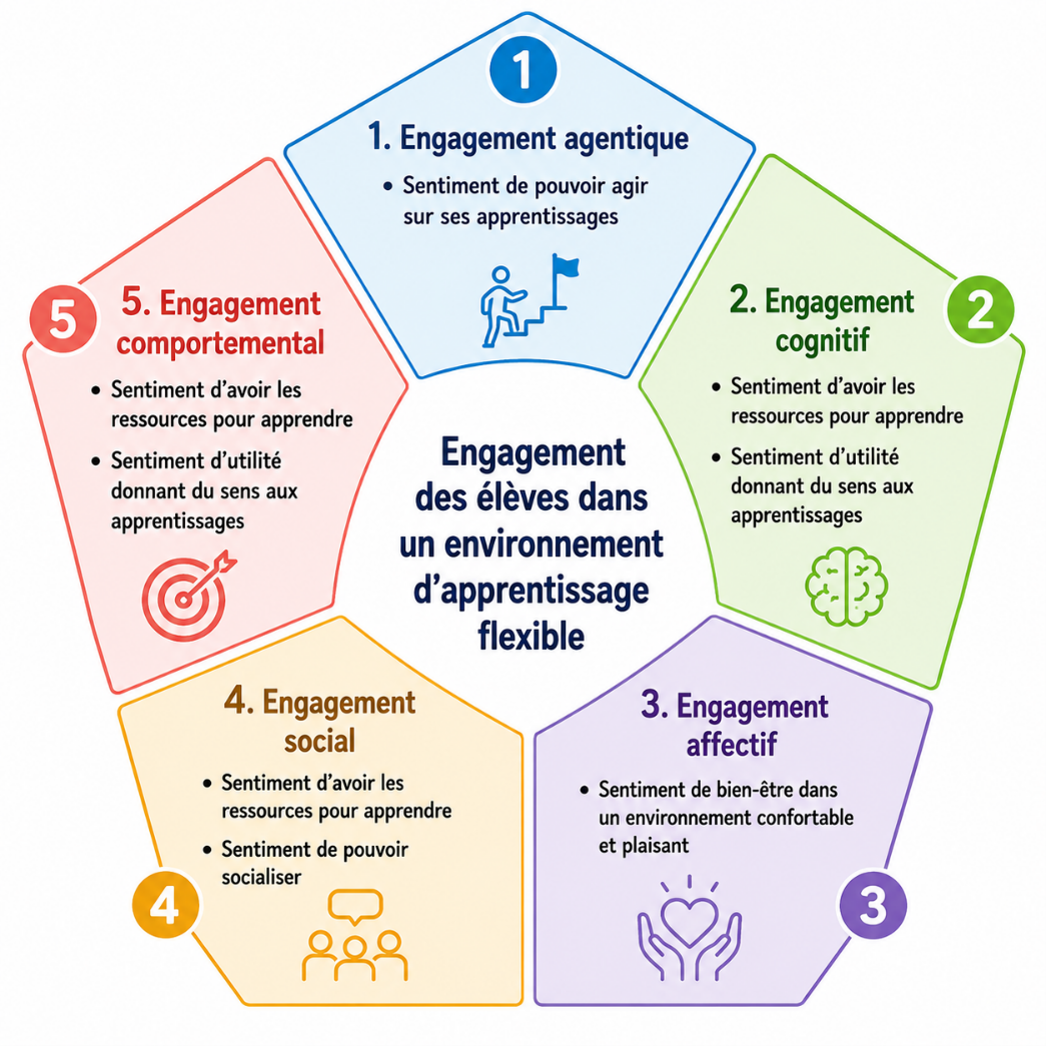
This study explores, from the students’ perspectives, how a pedagogical innovation that transforms schools into flexible learning environments influences their engagement at school. In spring 2022, during a second round of data collection (following an initial phase in 2021), we conducted semi-structured interviews with 20 students across three schools (Grades 7–12). These interviews enabled us to identify the perceived benefits of flexible learning environments, as implemented by the French-language school system of New Brunswick, in supporting student engagement. Using a thematic analysis, we identified five themes: a sense of agency in learning, a sense of having the resources needed to learn, a sense of purpose, a sense of opportunities for social interaction, and a sense of well-being. These themes suggest that, within a flexible learning environment, students tend to value self-directed tasks that are carried out in collaboration with their peers and perceived as meaningful and connected to everyday life, while also seeking meaningful interactions with teachers. These findings indicate that flexible learning environments may support the goal of the francophone school system in New Brunswick to foster student engagement.
Metrics
References
Allen, K.-A. et Boyle, C. (2022). School belonging and student engagement: The critical overlaps, similarities, and implications for student outcomes. Dans A. L. Reschly et S. L. Christenson (dir.), Handbook of research on student engagement (2e éd., p. 133–154). Springer. https://doi.org/10.1007/978-3-031-07853-8_7
Almulla, M. A. (2020). The effectiveness of the project-based learning (PBL) Approach as a way to engage students in learning. SAGE Open, 10(3). https://doi.org/10.1177/2158244020938702
Archambault, I. et Dupéré, V. (2017). Joint trajectories of behavioral, affective, and cognitive engagement in elementary school. The Journal of Educational Research, 110(2), 188–198. https://doi.org/10.1080/00220671.2015.1060931
Azevedo, R., Rosário, P., Núñez, J. C., Vallejo, G., Fuentes, S. et Magalhães, P. (2023). A school-based intervention on elementary students’ school engagement. Contemporary Educational Psychology, 73(5), article 102148. https://doi.org/10.1016/j.cedpsych.2023.102148
Barrett, P., Davies, F., Zhang, Y. et Barrett, L. (2017). The holistic impact of classroom spaces on learning in specific subjects. Environment and Behavior, 49(4), 425–451. https://doi.org/10.1177/0013916516648735
Ben Sassi, M. et Laroussi, M. (2011). Scénarios malléables à base de traces. Proposition d’une approche à base d’analyse de traces pour la conception de scénarios pédagogiques malléables. Atelier EIAH « Personnalisation de l’apprentissage », Mons. https://www.academia.edu/2642701/Sc%C3%A9narios_mall%C3%A9ables_%C3%A0_base_de_traces?auto=download
Benade, L. (2019). Flexible learning spaces: Inclusive by design? New Zealand Journal of Educational Studies, 54(1), 53–68 https://
doi.org/10.1007/s40841-019-00127-2
Blumenfeld, P. C., Modell, J., Bartko, W. T., Secada, W., Fredricks, J., Friedel, J. et Parks, A. (2005). School engagement of inner city students during middle childhood. Dans C. R. Cooper, C. T. García Coll, W. T. Bartko, H. Davis et C. Chatman (dir.), Developmental pathways through middle childhood: Rethinking contexts and diversity as resources (p. 145–170). Lawrence Erlbaum Associates.
Bluteau, J. (2022). Introduction au numéro thématique « Didactique et pédagogie en aménagement flexible ». Didactique, 3(1), 4–10. https://doi.org/10.37571/2022.0101
Bluteau, J., Arseneault, C., Aubenas, S. et Dufour, F. (2022). L’aménagement flexible des classes au Québec : une étude descriptive. Didactique, 3(1), 141–167. https://doi.org/10.37571/2022.0107
Bluteau, J., Aubenas, S., Dufour, F. et Carrier, L. (2019). La classe flexible est-elle un passage de mode ? La Foucade, 20(1), 19–20. https://cqjdc.org/revue-la-foucade/20-1/
Bocquillon, M., Gauthier, C., Bissonnette, S. et Derobertmasure, A. (2020). Enseignement explicite et développement de compétences : antinomie ou nécessité ? Formation et profession, 28(2), 3–18. https://dx.doi.org/10.18162/fp.2020.513
Burton, R. et Flammang, C. (2001). D’une stratégie d’enseignement des sciences centrée sur l’enseignant vers une stratégie centrée sur l’élève : analyse des processus d’enseignement. Les Dossiers des Sciences de l’Éducation, (5), 53–65. https://doi.org/10.3406/dsedu.2001.950
Byers, T., Imms, W. et Hartnell-Young, E. (2018). Evaluating teacher and student spatial transition from a traditional classroom to an innovative learning environment. Studies in Educational Evaluation, 58, 156–166. https://doi.org/10.1016/j.stueduc.2018.07.004
Capitanescu Benetti, A. et Grau, S. (2025). Flexibiliser la classe pour faire progresser les élèves. ESF.
Cardellino, P. et Woolner, P. (2020). Designing for transformation – a case study of open learning spaces and educational change. Pedagogy, Culture & Society, 28(3), 383–402. https://doi.org/10.1080/14681366.2019.1649297
Carvalho, L. (2020). (Re)Shaping spaces for learning: Experiences from Aotearoa New Zealand. The New Zealand Annual Review of Education, 26, 52–59. https://doi.org/10.26686/nzaroe.v26.6858
Carvalho, L. et Yeoman, P. (2021). Performativity of materials in learning: The learning-whole in action. Journal of New Approaches in Educational Research, 10(1), 28–42. https://doi.org/10.7821/naer.2021.1.627
Cayubit, R. F. O. (2021). Why learning environment matters? An analysis on how the learning environment influences the academic motivation, learning strategies and engagement of college students. Learning Environments Research, 25, 581–599. https://doi.org/10.1007/s10984-021-09382-x
Chervel, A. (1988). L’histoire des disciplines scolaires. Réflexions sur un domaine de recherche. Histoire de l’éducation, (38), 59–119. https://doi.org/10.3406/hedu.1988.1593
Chiasson, M. (2019, 6 avril). The relationship between learning spaces and the development of computational thinking skill [Communication]. American Education Research Association (AERA) Annual Meeting, Toronto, Canada. https://doi.org/10.3102/1440741
Connac, S. (2025). Perceptions par les enseignants d’une approche phénoménologique du tutorat entre élèves à l’école primaire. Recherches en éducation, (59), 72–86. https://doi.org/10.4000/140tz
Connac, S., Hueber, C. et Lanneau, L. (2022). Aménagements flexibles et coopération entre élèves. Didactique, 3(1), 11–36. https://doi.org/10.37571/2022.0102
Cornelius-White, J. (2007). Learner-centered teacher-student relationships are effective: A meta-analysis. Review of Educational Research, 77(1), 113–143. https://doi.org/10.3102/003465430298563
Creten, H., Lens, W. et Simons, J. (2002). The role of perceived instrumentality in student motivation. Dans A. Efklides, J. Kuhl et R. M. Sorrentino (dir.), Trends and prospects in motivation research (p. 37–45). Springer.
Delboé, G. (2024). Pour que les élèves se mobilisent. Cahiers pédagogiques, (591), 45–47. https://doi.org/10.3917/cape.591.0045
Denizot, N. (2023). « Culture scolaire » et « scolarisation » : des concepts didactiques pour questionner la « forme scolaire ». Raisons éducatives, 27(1), 35–50. https://doi.org/10.3917/raised.027.0035
Dubeau, A., Frenay, M. et Samson, G. (2015). L’utilité perçue de la tâche : présentation du concept et état de la recherche. Revue canadienne de l’éducation, 38(1), 1–23. https://cje-rce.ca/cje/index.php/cje-rce/article/view/1757
Finn, J. D. et Zimmer, K. S. (2022). Student engagement: What is it? Why does it matter? Dans A. L. Reschly et S. L. Christenson (dir.), Handbook of research on student engagement (2e éd., p. 133–154). Springer.
Fortin, M.-F. et Gagnon, J. (2022). Fondements et étapes du processus de recherche. Méthodes quantitatives et qualitatives (4e éd.). Chenelière éducation.
Fredricks, J. A., Blumenfeld, P. C. et Paris, A. H. (2004). School engagement: Potential of the concept, state of the evidence. Review of Educational Research, 74(1), 59–109. https://doi.org/10.3102/00346543074001059
Freiman, V., Chiasson, M., Bertin-Post, M., Godin, J., Léger, M. T. et Robichaud, X. (2022, 21 avril). Transforming learning spaces, teaching, and learning approaches to better reflect the challenges of a complex world [Communication]. American Education Research Association (AERA) Annual Meeting, San Diego, California. https://doi.org/10.3102/1893692
Gracyalny, J. R. et Hurtienne, L. E. (2023). The perceived effect of learner-centered pedagogy in secondary active learning spaces and impact on student engagement. Journal of Learning Spaces, 12(1), 75–91. https://files.eric.ed.gov/fulltext/EJ1400305.pdf
Grannäs, J., Frelin, A. et Östlin, T. (2026). Unpacking flexibility in innovative learning environments - teachers’ experiences in practice. Educational Studies, 52(1), 76–92. https://doi.org/10.1080/03055698.2024.2448781
Husman, J. et Shell, D. F. (2008). Beliefs and perceptions about the future: A measurement of future time perspective. Learning and Individual Differences, 18(2), 166–175. https://doi.org/10.1016/j.lindif.2007.08.001
Jézégou, A. (2022). Agentivité. Dans A. Jorro (dir.), Dictionnaire des concepts de la professionnalisation (2e éd., p. 41–44). De Boeck Supérieur.
Kallio, J. M. (2018). Participatory design of classrooms: Infrastructuring education reform in K-12 personalized learning programs. Journal of Learning Spaces, 7(2), 35–49.https://doi.org/10.3917/dbu.jorro.2022.01.0041
Kariippanon, K. E., Cliff, D. P., Ellis, Y. G., Ucci, M., Okely, A. D. et Parrish, A.-M. (2021). School flexible learning spaces, student movement behavior and educational outcomes among adolescents: A mixed-methods systematic review. Journal of School Health, 91(2), 133–145. https://doi.org/10.1111/josh.12984
Kariippanon, K. E., Cliff, D. P., Lancaster, S. L., Okely, A. D. et Parrish, A.-M. (2018). Perceived interplay between flexible learning spaces and teaching, learning and student wellbeing. Learning Environments Research, 21(5), 301–320. https://doi.org/10.1007/s10984-017-9254-9
Kariippanon, K. E., Cliff, D. P., Okely, A. D. et Parrish, A.-M. (2020). The ‘why’ and ‘how’ of flexible learning spaces: A complex adaptive systems analysis. Journal of Educational Change, 21(4), 569–593. https://doi.org/10.1007/s10833-019-09364-0
Kariippanon, K. E., Cliff, D. P., Okely, A. D. et Parrish, A.-M. (2019). Flexible learning spaces facilitate interaction, collaboration and behavioural engagement in secondary school. PLoS ONE, 14(10), article e0223607. https://doi.org/10.1371/journal.pone.0223607
Lanaris, C. et Savoie-Zajc, L. (2008). L’appropriation de la pédagogie par projet en tant que facteur contributoire a la réussite scolaire des élèves (no 2004-PS-95373). Université du Québec en Outaouais. https://frq.gouv.qc.ca/app/uploads/2021/08/pt_lanarise_rapport-2008_pedagogie-par-projets_facteur-de-reussite.pdfhttps://frq.gouv.qc.ca/app/uploads/2021/08/pt_lanarise_rapport-2008_pedagogie-par-projets_facteur-de-reussite.pdf
Land, S. M., Hannafin, M. J. et Oliver, K. M. (2012). Student-centered learning environments: Foundations, assumptions and design. Dans S. M. Land et D. Jonassen (dir.), Theoretical foundations of learning environments (2e éd., p. 3–25). Routledge.
Lee, H. Y., Ramsay, C. M. et Robert, J. (2023). The effects of furnishings and technology on pedagogical agility and student engagement across flexible learning spaces. Journal of Learning Spaces, 12(1), 23–32.
Leroux, M., Soro, Z., Bergeron, J., Bergeron, L., Berrigan, F., Deschênes, G., Malboeuf-Hurtubise, C., Smith, J. et Turcotte, S. (2022). L’aménagement flexible de la classe sous les projecteurs : analyse des retombées sur les apprentissages des élèves ainsi que sur les pratiques pédagogiques d’enseignantes du primaire. Didactique, 3(1), 64–93. https://doi.org/10.37571/2022.0104
MacDonald, F. J., Bottrell, D. et Johnson, B. (2019). Socially transformative wellbeing practices in flexible learning environments: Invoking an education of hope. Health Education Journal, 78(4), 377–387. https://doi.org/10.1177/0017896918777005
Mackenzie, N. et Knipe, S. (2006). Research dilemmas: Paradigms, methods and methodology. Issues in Educational Research, 16(2), 193–205. http://www.iier.org.au/iier16/mackenzie.html
Mazalto, M. et Paltrinieri, L. (2013). Introduction. Espaces scolaires et projets éducatifs. Revue internationale d’éducation de Sèvres, (64), 31–40. https://doi.org/10.4000/ries.3592
Milmeister, P., Kerger, S., Poncelet, D. et Dierendonck, C. (2021). L’engagement cognitif et comportemental des élèves dans l’enseignement secondaire au Luxembourg. Dans C. Houssemand (dir.), Recherches actuelles en psychologie différentielle (p. 75–86). Université du Luxembourg.
Ministère de l’Éducation et du Développement de la petite enfance (MEDPE). (2025). Document de discussion sur le prochain plan d’éducation - Secteur francophone. Gouvernement du Nouveau-Brunswick. https://www.gnb.ca/content/dam/GNB3/gov/cemc/doc/francophone-sector-education-plan.pdf
Nguyen, T. D., Cannata, M. et Miller, J. (2018). Understanding student behavioral engagement: Importance of student interaction with peers and teachers. The Journal of Educational Research, 111(2), 163–174. https://psycnet.apa.org/doi/10.1080/00220671.2016.1220359
Niemi, K. (2021). ‘The best guess for the future?’ Teachers’ adaptation to open and flexible learning environments in Finland. Education Inquiry, 12(3), 282–300. https://doi.org/10.1080/20004508.2020.1816371
Oliveras-Ortiz, Y., Bouillion, D. E. et Asbury, L. (2021). Learning Spaces Matter: Student Engagement in New Learning Environments. Journal of Education, 201(3), 174–182. https://doi.org/10.1177/0022057420908062
Ozkan Bekiroglu, S., Ramsay, C. M. et Robert, J. (2022). Movement and engagement in flexible, technology-enhanced classrooms: Investigating cognitive and emotional engagement from the faculty perspective. Learning Environments Research, 25(2), 359–377. https://doi.org/10.1007/s10984-021-09363-0
Paillé, P. et Mucchielli, A. (2021). L’analyse qualitative en sciences humaines et sociales. Armand Colin.
Patall, E. A., Yates, N., Lee, J., Chen, M., Bhat, B. H., Lee, K., Beretvas, S. N., Lin, S., Man Yang, S., Jacobson, N. G., Harris, E. et Hanson, D. J. (2024). A meta-analysis of teachers’ provision of structure in the classroom and students’ academic competence beliefs, engagement, and achievement. Educational Psychologist, 59(1), 42–70. https://doi.org/10.1080/00461520.2023.2274104
Reeve, J. et Jang, H. (2022). Agentic engagement. Dans A. L. Reschly et S. L. Christenson (dir.), Handbook of research on student engagement (2e éd., p. 95–107). Springer.
Reeve, J. et Tseng, C.-M. (2011). Agency as a fourth aspect of students’ engagement during learning activities. Contemporary Educational Psychology, 36(4), 257–267. https://doi.org/10.1016/j.cedpsych.2011.05.002
Reschly, A. L. et Christenson, S. L. (2022). Jingle, jangle, and conceptual haziness: Evolution and future directions of the engagement construct. Dans A. L. Reschly et S. L. Christenson (dir.), Handbook of research on student engagement (2e éd., p. 3–24). Springer.
Richards, L. (2021). Handling qualitative data: A practical guide (4e éd.) SAGE. https://doi.org/10.4135/9781036232429
Roorda, D. L., Koomen, H. M. Y., Spilt, J. L. et Oort, F. J. (2011). The influence of affective teacher–student relationships on students’ school engagement and achievement: A meta-analytic approach. Review of Educational Research, 81(4), 493–529. https://doi.org/10.3102/0034654311421793
Ryan, R. M. et Deci, E. L. (2018). Self-determination theory: Basic psychological needs in motivation, development, and wellness. Guilford Press.
Sahlberg, P. (2023). Trends in global education reform since the 1990s: Looking for the right way. International Journal of Educational Development, 98, article 102748. https://doi.org/10.1016/j.ijedudev.2023.102748
Savoie-Zajc, L. (2000). La recherche qualitative/interprétative en éducation. Dans T. Karsenti et L. Savoie-Zajc (dir.), Introduction à la recherche en éducation (p. 171–198). Éditions du CRP.
Sawers, K. M., Wicks, D., Mvududu, N., Seely, L. et Copeland, R. (2016). What drives student engagement: Is it learning space, instructor behavior, or teaching philosophy? Journal of Learning Spaces, 5(2), 26–38. https://files.eric.ed.gov/fulltext/EJ1152659.pdf
Shernoff, D. J. (2013). Optimal learning environments to promote student engagement. Springer. https://doi.org/10.1007/978-1-4614-7089-2
Skinner, E. A. et Pitzer, J. R. (2022). Developmental dynamics of student engagement, coping, and everyday resilience. Dans A. L. Reschy et S. L. Christenson (dir.), Handbook of research on student engagement (2e éd., p. 25–56). Springer.
Steele, J. P. et Fullagar, C. J. (2009). Facilitators and outcomes of student engagement in a college setting. The Journal of Psychology: Interdisciplinary and Applied, 143(1), 5–27. https://doi.org/10.3200/JRLP.143.1.5-27
Tremblay-Wragg, É., Messier, G., Raby, C. et Latulipe, N. (2025). Quelles stratégies pour l’enseignement ? Une revue intégrative de classifications qui les répertorient. Didactique, 6(1), 1–35. https://doi.org/10.37571/2025.0101
UNESCO. (2020). Global education monitoring report 2020. Inclusion and education: All means all. https://doi.org/10.54676/JJNK6989
Wang, M.-T., Degol, J. L. et Henry, D. A. (2019). An integrative development-in-sociocultural-context model for children’s engagement in learning. American Psychologist, 74(9), 1086–1102. https://doi.org/10.1037/amp0000522
Waters, L. (2021). Positive education pedagogy: Shifting teacher mindsets, practice, and language to make wellbeing visible in classrooms. Dans M. L. Kern, M. L. Wehmeyer (dir.), The Palgrave handbook of positive education (p. 137–164). Springer. https://psycnet.apa.org/doi/10.1007/978-3-030-64537-3_6
Wong, Z. Y. et Liem, G. A. D. (2022). Student engagement: Current state of the construct, conceptual refinement, and future research directions. Educational Psychology Review, 34, 107–138. https://doi.org/10.1007/s10648-021-09628-3
Yesil, L. B. et Saralar-Aras, I. (2024). The significance of flexible learning spaces and student-centred pedagogies in school settings: A comparative case study. International Education Journal: Comparative Perspectives, 23(1), 1–24. https://openjournals.library.sydney.edu.au/IEJ/article/view/15573
Young, F., Tuckwell, D. et Cleveland, B. (2022). Actualising the affordances of innovative learning environments through co-creating practice change with teachers. The Australian Educational Researcher, 49, 805–826. https://doi.org/10.1007/s13384-021-00447-7
Zimmerman, B. J. (2002). Becoming a self-regulated learner: An overview. Theory into practice, 41(2), 64–70. https://doi.org/10.1207/s15430421tip4102_2
Downloads
Published
How to Cite
Issue
Section
License
Copyright (c) 2026 Xavier Robichaud, Viktor Freiman, Jeanne Godin, Kim Thériault, Julie Roy, Claire Johnson, Michel Léger , Mireille Bertin-Post, Mario Chiasson

This work is licensed under a Creative Commons Attribution-NonCommercial-NoDerivatives 4.0 International License.
The Canadian Journal of Education follows Creative Commons Licencing CC BY-NC-ND.