Profils de valeurs de travail et centralité du travail chez des élèves du secondaire
DOI :
https://doi.org/10.53967/cje-rce.5937Mots-clés :
valeurs de travail, centralité du travail, profils latents, école secondaireRésumé
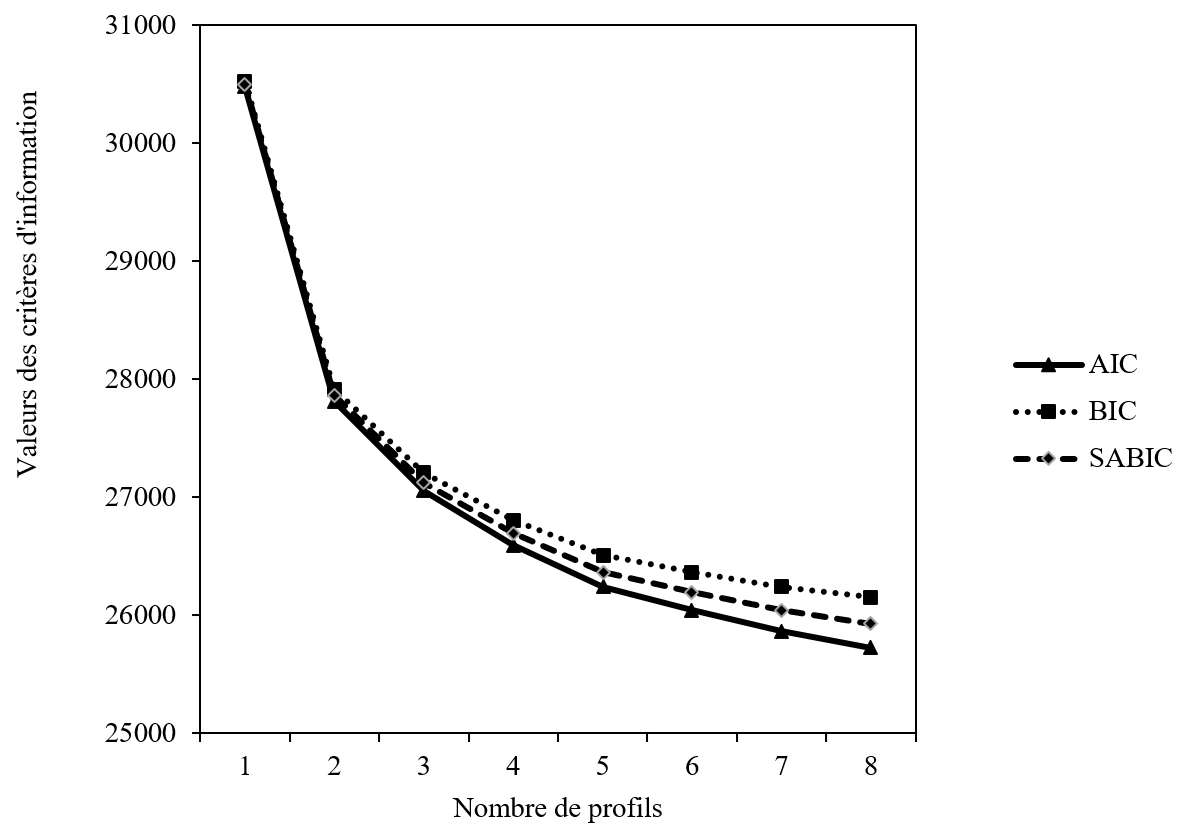
Le modèle en quatre facteurs de valeurs de travail (MQF-VT) a été développé et validé empiriquement pour incorporer les principales valeurs de travail recensées dans les écrits scientifiques. Cet article vise à vérifier la présence de profils de valeurs de travail sur la base du MQF-VT à partir d’un échantillon d’élèves québécois du secondaire (n = 3 083). Il vise également à décrire l’association entre les profils dégagés et la centralité du travail (c’est-à-dire l’importance qu’une personne accorde au travail dans sa vie), ainsi que les caractéristiques sociodémographiques. D’abord, un questionnaire en ligne a servi à récolter les données. Ensuite, une analyse de modélisation par équation structurelle exploratoire a permis d’estimer la structure factorielle du MQF-VT. Puis, une analyse de profils latents a permis d’obtenir cinq profils généralement similaires à ceux identifiés dans une précédente étude. Enfin, une analyse de comparaisons des profils indique que le niveau de centralité du travail varie selon l’appartenance à un profil. L’originalité de cet article est de soutenir la validité du modèle théorique et de la solution de profils qui en découle, ce qui contribue à sa généralisation. Dans la pratique, les résultats montrent l’importance pour les spécialistes de l’orientation de mobiliser les valeurs de travail dans leurs interventions auprès des élèves du secondaire.
Statistiques
Références
Asparouhov, T. et Muthén, B. (2009). Exploratory structural equation modeling. Structural Equation Modeling: A Multidisciplinary Journal, 16(3), 397–438. https://doi.org/10.1080/10705510903008204
Asparouhov, T. et Muthén, B. (2021, 4 février). Auxiliary variables in mixture modeling: Using the BCH method in Mplus to estimate a distal outcome model and an arbitrary secondary model (Version 11) [Mplus web notes no 21]. http://www.statmodel.com/examples/webnotes/webnote21.pdf
Balsamo, M., Lauriola, M. et Saggino, A. (2013). Work values and college major choice. Learning and Individual Differences, 24, 110–116. https://doi.org/10.1016/j.lindif.2012.12.022
Berlin, K. S., Williams, N. A. et Parra, G. R. (2014). An introduction to latent variable mixture modeling (Part 1): Overview and cross-sectional latent class and latent profile analyses. Journal of Pediatric Psychology, 39(2), 174–187. https://doi.org/10.1093/jpepsy/jst084
Bourdon, S., Baril, D., Desroches, I., Dionne, P. et Supeno, E. (2020). Résultats du sondage Rapports au travail, orientation et persévérance aux études, du secondaire à l’université (RTOPS). Chaire-réseau de recherche sur la jeunesse du Québec (CRJ). https://www.carrefourfga.ca/SARCA-DEAFP/wp-content/uploads/2020/12/CRJ_Bourdon_SondageRTOPS-VFF.pdf
Bréchon, P. (dir.) (2000). Les valeurs des Français. Évolution de 1980 à 2000. Armand Colin.
Buchholz, R. A. (1978). An empirical study of contemporary beliefs about work in American society. Journal of Applied Psychology, 63(2), 219–227. https://doi.org/10.1037/0021-9010.63.2.219
Bujold, C., Fournier, G. et Lachance, L. (2013). The meaning of work among nonstandard workers: A multifaceted reality. Canadian Journal of Counselling and Psychotherapy, 47(4), 480–499. https://cjc-rcc.ucalgary.ca/article/view/6091
Busque-Carrier, M., Le Corff, Y. et Ratelle, C. F. (2022a). Development and validation of the integrative work values scale. European Review of Applied Psychology, 72(5), article 100766. https://doi.org/10.1016/j.erap.2022.100766
Busque-Carrier, M., Ratelle, C. F. et Le Corff, Y. (2022b). Work values and job satisfaction: The mediating role of basic psychological needs at work. Journal of Career Development, 49(6), 1386–1401. https://doi.org/10.1177/08948453211043878
Busque-Carrier, M., Ratelle, C. F. et Le Corff, Y. (2022c). Linking work values profiles to basic psychological need satisfaction and frustration. Psychological Reports, 125(6), 3183–3208. https://doi.org/10.1177/00332941211040439
Cohen, J. (1988). Statistical power analysis for the behavioral sciences. Erlbaum.
Dose, J. J. (1997). Work values: An integrative framework and illustrative application to organizational socialization. Journal of Occupational and Organizational Psychology, 70(3), 219–240. https://doi.org/10.1111/j.2044-8325.1997.tb00645.x
Fouad, N. A., Burrows, S. G., Avery, C. et Ezema, G. (2024). Changes in U.S. workers’ values and satisfaction after COVID-19. Journal of Career Assessment, 32(2), 321–342. https://doi.org/10.1177/10690727231194786
Greene, J. A. et Messer, M. A. (2018). Best practices for selecting, administering, and interpreting career assessments: A case study with the work values inventory. Career Planning & Adult Development Journal, 33(4), 33–44.
Guo, J., Eccles, J. S., Sortheix, F. M. et Salmela-Aro, K. (2018). Gendered pathways toward STEM careers: The incremental roles of work value profiles above academic task values. Frontiers in Psychology, 9, article 1111. https://doi.org/10.3389/fpsyg.2018.01111
Hair, J. F. Jr., Black, W. C., Babin, B. J. et Anderson, R. E. (2010). Multivariate data analysis (7e éd.). Pearson Prentice Hall.
Hipp, J. R. et Bauer, D. J. (2006). Local solutions in the estimation of growth mixture models. Psychological Methods, 11(1), 36–53. https://doi.org/10.1037/1082-989X.11.1.36
Hofmans, J., Wille, B. et Schreurs, B. (2020). Person-centered methods in vocational research. Journal of Vocational Behavior, 118, article 103398. https://doi.org/10.1016/j.jvb.2020.103398
Howard, J., Gagné, M., Morin, A. J. S. et Van den Broeck, A. (2016). Motivation profiles at work: A self-determination theory approach. Journal of Vocational Behavior, 95-96, 74–89. https://doi.org/10.1016/j.jvb.2016.07.004
Jin, J. et Rounds, J. (2012). Stability and change in work values: A meta-analysis of longitudinal studies. Journal of Vocational Behavior, 80(2), 326–339. https://doi.org/10.1016/j.jvb.2011.10.007
Koh, C. W. (2016). Work-value profile and career success [Thèse de doctorat, University of South Florida]. Digital commons. https://digitalcommons.usf.edu/etd/6281
Kostek, J. (2012). Work centrality: A meta-analysis of the nomological network. [Mémoire de maîtrise, Bowling Green State University]. OhioLINK. https://etd.ohiolink.edu/acprod/odb_etd/ws/send_file/send?accession=bgsu1339525599&disposition=inline
Lee, J., Lee, Y., Kim, S. J. et Song, J. H. (2022). Work values: A latent class analysis of Korean employees. Higher Education, Skills and Work-Based Learning, 12(5), 834–848. https://doi.org/10.1108/HESWBL-10-2021-0188
Kuron, L. K. J., Schweitzer, L., Lyons, S. et Ng, E. S. W. (2016). Career profiles in the “new career”: Evidence of their prevalence and correlates. Career Development International, 21(4), 355–377. https://doi.org/10.1108/CDI-05-2015-0066
Marsh, H. W., Hau, K.-T. et Grayson, D. (2005). Goodness of fit in structural equation models. Dans A. Maydeu-Olivares et J. J. McArdle (dir.), Multivariate applications book series. Contemporary psychometrics: A festschrift for Roderick P. McDonald (p. 275–340). Lawrence Erlbaum Associates.
Masyn, K. E. (2013). Latent class analysis and finite mixture modeling. Dans T. D. Little (dir.), The Oxford handbook of quantitative methods. Volume 2 statistical analysis (p. 551–611). Oxford University Press.
Mercure, D. et Vultur, M. (2010). La signification du travail. Nouveau modèle productif et ethos du travail au Québec. Presses de l’Université Laval.
Merz, E. L. et Roesch, S. C. (2011). A latent profile analysis of the five factor model of personality: Modeling trait interactions. Personality and Individual Differences, 51(8), 915–919. https://doi.org/10.1016/j.paid.2011.07.022
Meyer, J. P., Stanley, L. J. et Vandenberg, R. J. (2013). A person-centered approach to the study of commitment. Human Resource Management Review, 23(2), 190–202. https://doi.org/10.1016/j.hrmr.2012.07.007
Moniarou-Papaconstantinou, V. et Triantafyllou, K. (2015). Job satisfaction and work values: Investigating sources of job satisfaction with respect to information professionals. Library & Information Science Research, 37(2), 164–170. https://doi.org/10.1016/j.lisr.2015.02.006
Morin, A. J. S. et Marsh, H. W. (2015). Disentangling shape from level effects in person-centered analyses: An illustration based on university teachers’ multidimensional profiles of effectiveness. Structural Equation Modeling: A Multidisciplinary Journal, 22(1), 39–59. https://doi.org/10.1080/10705511.2014.919825
Morin, A. J. S., Meyer, J. P., Creusier, J. et Biétry, F. (2016). Multiple-group analysis of similarity in latent profile solutions. Organizational Research Methods, 19(2), 231–254. https://doi.org/10.1177/1094428115621148
Murdock, C. et Rounds, J. (2014). Work values: Understanding and assessing motivation to work. Dans D. R. Strauser (dir.), Career development, employment and disability in rehabilitation: From theory to practice (p. 193–206). Springer.
Muthén et Muthén (2019). Mplus Version 8.4 [logiciel]. https://www.statmodel.com/index.shtml
Nord, W. R., Brief, A. P., Atieh, J. M. et Doherty, E. M. (1988). Work values and the conduct of organizational behavior. Dans B. M. Staw et L. L. Cummings (dir.), Research in organizational behavior (volume 10, p. 1–42). JAI Press.
Nylund-Gibson, K. et Choi, A. Y. (2018). Ten frequently asked questions about latent class analysis. Translational Issues in Psychological Science, 4(4), 440–461. https://doi.org/10.1037/tps0000176
Paullay, I. M., Alliger, G. M. et Stone-Romero, E. F. (1994). Construct validation of two instruments designed to measure job involvement and work centrality. Journal of Applied Psychology, 79(2), 224–228. https://doi.org/10.1037/0021-9010.79.2.224
Ros, M., Schwartz, S. H. et Surkiss, S. (1999). Basic individual values, work values, and the meaning of work. Applied Psychology: An International Review, 48(1), 49–71. http://doi.org/10.1080/026999499377664
Schreurs, B., van Emmerik, I. H., Van den Broeck, A. et Guenter, H. (2014). Work values and work engagement within teams: The mediating role of need satisfaction. Group Dynamics: Theory, Research, and Practice, 18(4), 267–281. https://doi.org/10.1037/gdn0000009
Schwartz, S. H., Cieciuch, J., Vecchione, M., Davidov, E., Fischer, R., Beierlein, C., Ramos, A., Verkasalo, M., Lönnqvist, J.-E., Demirutku, K., Dirilen-Gumus, O. et Konty, M. (2012). Refining the theory of basic individual values. Journal of Personality and Social Psychology, 103(4), 663–688. https://doi.org/10.1037/a0029393
Skrondal, A. et Laake, P. (2001). Regression among factor scores. Psychometrika, 66(4), 563–575. https://doi.org/10.1007/BF02296196
Spurk, D., Hirschi, A., Wang, M., Valero, D. et Kauffeld, S. (2020). Latent profile analysis: A review and “how to” guide of its application within vocational behavior research. Journal of Vocational Behavior, 120, article 103445. https://doi.org/10.1016/j.jvb.2020.103445
Su, R., Murdock, C. et Rounds, J. (2015). Person–environment fit. Dans P. J. Hartung, M. L. Savickas et W. B. Walsh (dir.), APA handbook of career intervention: Vol. 1. Foundations (p. 81–98). American Psychological Association.
Super, D. E. (1980). A life-span, life-space approach to career development. Journal of Vocational Behavior, 16(3), 282–298. http://doi.org/10.1016/0001-8791(80)90056-1
Vansteenkiste, M., Neyrinsck, B., Niemiec, C. P., Soenens, B., De Witte, H. et Van den Broeck, A. (2007). On the relations among work value orientations, psychological need satisfaction and job outcomes: A self-determination theory approach. Journal of Occupational and Organizational Psychology, 80(2), 251–277. https://doi.org/10.1348/096317906X111024
Téléchargements
Publié-e
Comment citer
Numéro
Rubrique
Licence
© Société canadienne pour l'étude de l'éducation 2025

Cette œuvre est sous licence Creative Commons Attribution - Pas d'Utilisation Commerciale - Pas de Modification 4.0 International.
La Revue canadienne de l’éducation utilise la licence CC BY-NC-ND de Creative Commons.