Consensus des directions d’établissement d’enseignement du Québec envers un devis de compétence numérique requise à l’égard des technologies numériques
DOI:
https://doi.org/10.53967/cje-rce.6951Keywords:
School administration, school principals, digital competency, competencies, competency frameworks, digital technologies, Delphi methodAbstract
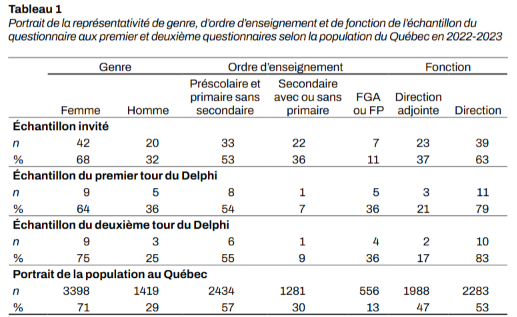
A digital competency framework was created, based on competency statements developed from interviews with school principals in Quebec and the analysis of professional competency frameworks from different countries referencing digital technologies. To ensure this digital competency framework reflects the perceptions of principals, it was submitted to a sample of 14 school principals who were asked to express their level of agreement with 160 statements in a two-round Delphi study. The study results showed that the majority of proposed statements reached a moderate to high consensus among participants. Participants’ comments indicated that non-consensus on some statements was primarily due to shared responsibilities related to digital technologies. Future research could propose the framework to a larger sample to increase result validity or use it to conduct interviews or focus groups to deepen the understanding of the significance of the digital competency for school principals.
Metrics
References
Académie de la transformation numérique. (2023). Portrait des usages du numérique dans les écoles québécoises. Édition 2023. Université Laval. https://transformation-numerique.ulaval.ca/enquetes-et-mesures/autres-publications/portrait-des-usages-du-numerique-dans-les-ecoles-quebecoises-2023/
Aligica, P. D. et Herritt, R. (2009). Epistemology, social technology, and expert judgement: Olaf Helmer’s contribution to futures research. Futures, 41(5), 253–259. https://doi.org/10.1016/j.futures.2008.11.010
Bambirra Assunção, Y. et Barbosa Goulart, I. (2016). Professional training or competencies for the future? Future studies research journal, 8(1), 175–208. https://doi.org/10.24023/FutureJournal/2175-5825/2016.v8i1.249
BCPVPA Standards Committee. (2019). Leadership standards for principals and vice-principals in British Columbia 2019. https://bcpvpa.insite.com/files/assets/83/bcpvpaleadershipstandardsjuly2019.pdf
Conseil supérieur de l’éducation (CSE). (2020, novembre). Éduquer au numérique. Rapport sur l’état et les besoins de l’éducation 2018-2020. Le Conseil. https://www.cse.gouv.qc.ca/publications/eduquer-au-numerique-50-0534/
Council of Atlantic Ministers of Education and Training. (2020, juillet). Atlantic provinces standards of practice for school-based administrators. https://www.gov.nl.ca/education/files/Standards-of-Practice-final-Sept-2020.pdf
Delobbe, N. (2009). Modèles de gestion des compétences et orientations de la formation en entreprise. Dans J.-M. Barbier, É. Bourgeois, J.-C. Ruano-Borbalan, G. Chapelle (dir.), Encyclopédie de la formation. Presses universitaires de France. http://hdl.handle.net/2078/117347
Duval, S., Couttet, J. et Montminy, N. (2023). Content validation of an executive function observation tool using the Delphi method. Mesure et évaluation en éducation, 46(2), 1–40. https://doi.org/10.7202/1111097ar
Fortin, M.-F. et Gagnon, J. (2016). Fondements et étapes du processus de recherche. Méthodes quantitatives et qualitatives (3e éd.). Chenelière Éducation.
Gouvernement du Canada. (2010). Accroître l’avantage numérique du Canada : stratégies pour une prospérité durable. Document de consultation sur la stratégie sur l’économie numérique du Canada. Gouvernement du Canada. https://publications.gc.ca/collections/collection_2010/ic/Iu4-144-2010-fra.pdf
Habibi, A., Sarafrazi, A. et Izadyar, S. (2014). Delphi technique theoretical framework in qualitative research. The International Journal of Engineering and Science, 3(4), 8–13. https://www.researchgate.net/publication/272177606
Iqbal, S. et Pipon-Young, L. (2009). The Delphi method. The Psychologist, 22(7), 598–601. https://www.researchgate.net/publication/393624108
Jirwe, M., Gerrish, K., Keeney, S. et Emami, A. (2009). Identifying the core components of cultural competence: Findings from a Delphi study. Journal of Clinical Nursing, 18(18), 2622–2634. https://doi.org/10.1111/j.1365-2702.2008.02734.x
Jünger, S., Payne, S. A., Brine, J., Radbruch, L. et Brearley, S. G. (2017). Guidance on Conducting and REporting DElphi Studies (CREDES) in palliative care: Recommendations based on a methodological systematic review. Palliative Medicine, 31(8), 684–706. https://doi.org/10.1177/0269216317690685
Lacasse, M. et Héon, L. (2024). Référentiels de compétences professionnelles de directions d’établissement d’enseignement et technologies numériques : une analyse documentaire, structurale et sémantique. Revue canadienne en administration et politique de l’éducation, (204), 127–156. https://doi.org/10.7202/1111529ar
Lacasse, M. et Héon, L. (sous presse). Perceptions des directions d’établissement d’enseignement du Québec envers leur compétence numérique. Revue des sciences de l’éducation de McGill.
Lapointe, P., Poirel, E. et Chartrand, É. (2021, mai). Rapport d’enquête sur l’organisation du travail des directions d’établissement d’enseignement du Québec. Groupe de recherche interrégional sur l’organisation du travail des directions d’établissement d’enseignement du Québec. https://www.gride-qc.ca/wp-content/uploads/2021/07/Rapport-du-GRIDE_5.05.2021_compressed.pdf
Lasnier, F. (2000). Réussir la formation par compétences. Guérin.
Lasnier, F. (2001). Un modèle intégré pour l’apprentissage d’une compétence. Pédagogie collégiale, 15(1), 10.
Ministère de l’Éducation, du Loisir et du Sport [MELS]. (2008). La formation à la gestion d’un établissement d’enseignement : les orientations et les compétences professionnelles. Gouvernement du Québec. https://numerique.banq.qc.ca/patrimoine/details/52327/1563968
Ministère de l’Éducation et de l’Enseignement supérieur [MEES]. (2019). Cadre de référence de la compétence numérique. Gouvernement du Québec. https://numerique.banq.qc.ca/patrimoine/details/52327/4013989
Newton, P., Herron, A., Reid, K. et Steeves, J. (2017, novembre). LEADS Leadership Development Paper. LEADS Saskatchewan league of educational administrators directors & superintendents. https://saskleads.ca/wp-content/uploads/2023/01/LEADS_Leadership_Development_Paper_-_Final_November_2017.pdf
Northwest Territories Education, Culture and Employment. (2012). A guide to principal practice. Principal growth and evaluation in the Northwest Territories. https://www.ece.gov.nt.ca/sites/ece/files/resources/principal_growth_and_evaluation_guide.pdf
Nunavut Department of Education. (2018, avril). Nunavut professional standards for school leaders. Department of Education. https://www.gov.nu.ca/sites/default/files/documents/2023-12/schoolleadersprofessionalstandards_eng.pdf
O’Connor, B., Anderson, P., Bynum, M., Gaston, P., Guimaraes de Castro, M. H., Malyn-Smith, J., McGaw, B., Methia, R. et Taylor, L. A. (2002). Digital transformation. A framework for ICT literacy. International ICT Literacy Panel. https://www.ets.org/Media/Research/pdf/ICTREPORT.pdf
Organisation for Economic Co-operation and Development [OECD]. (2013). Learning standards, teaching standards and standards for school principals: A comparative study (Working Papers, no 99; publication no EDU/WKP(2013)14). https://dx.doi.org/10.1787/5k3tsjqtp90v-en
Skulmoski, G. J., Hartman, F. T. et Krahn, J. (2007). The Delphi method for graduate research. Journal of Information Technology Education: Research, 6, 001–021. https://doi.org/10.28945/199
Tremblay-Boudreault, V. (2012). Conception d’un outil de mesure de la charge de travail mentale dans le processus de retour au travail à la suite d’un trouble mental transitoire ayant engendré des incapacités prolongées [mémoire de maitrise, Université de Sherbrooke]. https://savoirs.usherbrooke.ca/handle/11143/6365
Yukon Association of Education Professionals. (2011). An educational leadership framework for Yukon principals and vice-principals. Yukon government.
Downloads
Published
How to Cite
Issue
Section
License
Copyright (c) 2026 Michel Lacasse, Lucie Héon

This work is licensed under a Creative Commons Attribution-NonCommercial-NoDerivatives 4.0 International License.
The Canadian Journal of Education follows Creative Commons Licencing CC BY-NC-ND.