Facteurs influençant l’identité scientifique d’étudiants de niveau collégial engagés dans une recherche scientifique authentique
DOI:
https://doi.org/10.53967/cje-rce.7357Keywords:
science identity, college students, authentic scientific research, qualitative researchAbstract
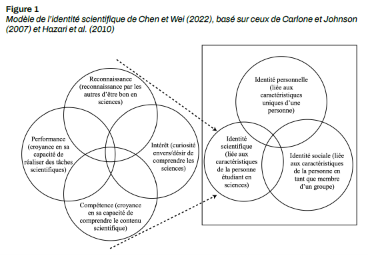
We present the results of a qualitative study of three CEGEP students who participated in authentic scientific research focused on the links between light pollution and cancer. As part of this project, the college students used scientific instruments, analyzed research data, interacted with university mentors, mentored high school students, and presented their findings at various scientific forums. We interviewed them three times during an academic year to track the development of their science identity according to four subcomponents (performance, competence, interest, and recognition) described by Chen and Wei’s (2022) model of science identity. The objective of this thematic analysis was to determine which elements of their participation in authentic scientific research would have the greatest influence on their science identity. Our results show that among the activities described above, working with mentors, using scientific instruments, reading scientific articles, and engaging in scientific communication all had a positive impact on the science identity of college students. Other activities that seemed less suited to their skill level, such as computer programming, had a rather demotivating effect. We conclude that authentic scientific activities carried out for educational purposes should respect the skill level of the participants and be more closely supervised than scientific activities carried out solely for the purpose of producing new knowledge. However, immersing students in a research context that is as authentic as possible has a positive effect on the development of their science identity and their understanding of what it means to be a “scientific person.”
Metrics
References
Anadón, M. et Savoie-Zajc, L. (2009). Introduction. L’analyse qualitative des données. Recherches qualitatives, 28(1), 1–7. https://doi.org/10.7202/1085318ar
Archer, L., DeWitt, J., Osborne, J., Dillon, J., Willis, B. et Wong, B. (2010). “Doing” science versus “being” a scientist: Examining 10/11-year-old schoolchildren’s constructions of science through the lens of identity. Science Education, 94(4), 617–639. https://doi.org/10.1002/sce.20399
Aschbacher, P. R., Li, E. et Roth, E. J. (2010). Is science me? High school students’ identities, participation and aspirations in science, engineering, and medicine. Journal of Research in Science Teaching, 47(5), 564–582. https://doi.org/10.1002/tea.20353
Aubé, M., Houle, J.-P., Desmarais, J., Veilleux, N. et Bordeleau, É. (2021). Modeling the spectral properties of obtrusive light incident on a window: Application to Montréal, Canada. Remote Sensing, 13(14), article 2767. https://doi.org/10.3390/rs13142767
Aubé, M., Marseille, C., Farkouh, A., Dufour, A., Simoneau, A., Zamorano, J., Roby, J. et Tapia, C. (2020). Mapping the melatonin suppression, star light and induced photosynthesis indices with the LANcube. Remote Sensing, 12(23), article 3954. https://doi.org/10.3390/rs12233954
Ault, C. R. (1994). Research on problem solving: Earth science. Dans D. L. Gabel (dir.), Handbook of Research on Science Teaching and Learning (p. 269–283). Macmillan.
Boutin, G. (2018). L’entretien de recherche qualitatif. Théorie et pratique. Presse de l’Université du Québec.
Braun, V. et Clarke, V. (2013). Successful qualitative research: A practical guide for beginners. SAGE.
Braund, M. et Reiss, M. (2006). Towards a more authentic science curriculum: The contribution of out-of-school learning. International Journal of Science Education, 28(12), 1373–1388. http://dx.doi.org/10.1080/09500690500498419
Brown, J. S., Collins, A. et Duguid, P. (1989). Situated cognition and the culture of learning. Educational Researcher, 18(1), 32–42. https://doi.org/10.3102/0013189X018001032
Burke, P. J. et Reitzes, D. C. (1981). The link between identity and role performance. Social Psychology Quarterly, 44(2), 83–92. https://doi.org/10.2307/3033704
Burke, P. J. et Stets, J. E. (2009). Identity theory. Oxford University Press.
Burrows, A. C., DiPompeo, M. A., Myers, A. D., Hickox, R. C., Borowczak, M., French, D. A. et Schwortz, A. C. (2016). Authentic science experiences: Pre-collegiate science educators’ successes and challenges during professional development. Problems of Education in the 21st Century, 70, 59–73. https://doi.org/10.33225/pec/16.70.59
Carlone, H. B. et Johnson, A. (2007). Understanding the science experiences of successful women of color: Science identity as an analytic lens. Journal of Research in Science Teaching, 44(8), 1187–1218. https://doi.org/10.1002/tea.20237
Chemers, M. M., Zurbriggen, E. L., Syed, M., Goza, B. K. et Bearman, S. (2011). The role of efficacy and identity in science career commitment among underrepresented minority students. Journal of Social Issues, 67(3), 469–491. https://doi.org/10.1111/j.1540-4560.2011.01710.x
Chen, S., Binning, K. R., Manke, K. J., Brady, S. T., McGreevy, E. M., Betancur, L., Limeri, L. B. et Kaufmann, N. (2021). Am I a science person? A strong science identity bolsters minority students’ sense of belonging and performance in college. Personality and Social Psychology Bulletin, 47(4), 593–606. https://doi.org/10.1177/0146167220936480
Chen, S. et Wei, B. (2022). Development and validation of an instrument to measure high school students’ science identity in science learning. Research in Science Education, 52, 111–126. https://doi.org/10.1007/s11165-020-09932-y
Chick, N. L., Haynie, A. et Gurung, R. A. (2009). Exploring signature pedagogies: Approaches to teaching disciplinary habits of mind. Stylus Publishing, LLC.
Cooper, A. C. et Bolger, M. S. (2024). The classroom-research-mentoring framework: A lens for understanding science practice-based instruction. Science Education, 108(1), 275–307. https://doi.org/10.1002/sce.21835
Creswell, J. W. et Creswell, J. D. (2017). Research design: Qualitative, quantitative, and mixed methods approaches. SAGE.
Crippen, K. J. et Archambault, L. (2012). Scaffolded inquiry-based instruction with technology: A signature pedagogy for STEM education. Computers in the Schools, 29(1-2), 157–173. https://doi.org/10.1080/07380569.2012.658733
Crowley, K., Barron, B. J., Knutson, K. et Martin, C. K. (2015). Interest and the development of pathways to science. Dans K. A. Renninger, M. Nieswandt et S. Hidi (dir.), Interest in mathematics and science learning (p. 297–314). AREA. https://www.researchgate.net/publication/309471804
Eagan, M. K., Romero, A. L. et Zhong, S. (2024). BUILDing an early advantage: An examination of the role of strategic interventions in developing first-year undergraduate students’ science identity. Research in Higher Education, 65, 181–207. https://doi.org/10.1007/s11162-023-09745-8
Eccles, J. (2009). Who am I and what am I going to do with my life? Personal and collective identities as motivators of action. Educational Psychologist, 44(2), 78–89. https://doi.org/10.1080/00461520902832368
Eccles, J. S., Fredricks, J. A. et Baay, P. (2015). Expectancies, values, identities, and self-regulation. Dans G. Oettingen et P. M. Gollwitzer (dir.), The Jacobs Foundation series on adolescence (p. 30–56). Cambridge University Press.
Fensham, P. J. (2009). Real world contexts in PISA science: Implications for context-based science education. Journal of Research in Science Teaching, 46(8), 884–896. https://doi.org/10.1002/tea.20334
Ferguson, S. L. et Lezotte, S. M. (2020). Exploring the state of science stereotypes: Systematic review and meta‐analysis of the Draw‐A‐Scientist checklist. School Science and Mathematics, 120(1), 55–65. https://doi.org/10.1111/ssm.12382
Garcia-Saenz, A., Sánchez de Miguel, A., Espinosa, A., Valentin, A., Aragonés, N., Llorca, J., Amiano, P., Martín Sánchez, V., Guevara, M., Capelo, R., Tardón, A., Peiró-Perez, R., Jiménez-Moleón, J. J., Roca-Barceló, A., Pérez-Gómez, B., Dierssen-Sotos, T., Fernández-Villa, T., Moreno-Iribas, C., Moreno, V., … Kogevinas, M. (2018). Evaluating the association between artificial light-at-night exposure and breast and prostate cancer risk in Spain (MCC-Spain study). Environmental Health Perspectives, 126(4), article 047011.
Garcia-Saenz, A., Sánchez de Miguel, A., Espinosa, A., Valentin A., Costas L., Castaño-Vinyals, G., Moreno, V., Pollan, M., Aubé, M. et Kogevinas, M. (2019, 25-28 août). Artificial light at night (ALAN), blue light spectrum exposure and colorectal cancer risk in Spain (MCC-Spain study) [Communication]. Conference of the International Society for Environmental Epidemiology, Utrecht, Netherlands. https://doi.org/10.1097/01.EE9.0000608172.33912.a5
Gardner, G. E., Forrester, J. H., Jeffrey, P. S., Ferzli, M. et Shea, D. (2015). Authentic science research opportunities: How do undergraduate students begin integration into a science community of practice? Journal of College Science Teaching, 44(4), 61–65. http://www.jstor.org/stable/43631866
Gaudreau, L. (2011). Guide pratique pour créer et évaluer une recherche scientifique. Guérin.
Gee, J. P. (2000). Chapter 3: Identity as an analytic lens for research in education. Review of Research in Education, 25(1), 99–125. https://doi.org/10.3102/0091732X025001099
Gonsalves, A. J., Cavalcante, A. S., Sprowls, E. D. et Iacono, H. (2021). “Anybody can do science if they’re brave enough”: Understanding the role of science capital in science majors’ identity trajectories into and through postsecondary science. Journal of Research in Science Teaching, 58(8), 1117–1151. https://doi.org/10.1002/tea.21695
Handelsman, J., Ebert-May, D., Beichner, R., Bruns, P., Chang, A., DeHaan, R., Gentile, J., Lauffer, S., Stewart, J., Tilghman, S. M. et Wood, W. B. (2004). Scientific Teaching. Science, 304(5670), 521–522. https://doi.org/10.1126/science.1096022
Hasni, A., Belletête, V. et Potvin, P. (2018). Les démarches d’investigation scientifique à l’école : un outil de réflexion sur les pratiques de classe. CREAS et CRIJEST. https://www.usherbrooke.ca/creas/fileadmin/sites/creas/documents/Publications/Demarches_Investigation_Hasni_Belletete_Potvin_2018.pdf
Hazari, Z., Sadler, P. M. et Sonnert, G. (2013). The science identity of college students: Exploring the intersection of gender, race, and ethnicity. Journal of College Science Teaching, 42(5), 82–91. https://www.jstor.org/stable/43631586
Hazari, Z., Sonnert, G., Sadler, P. M. et Shanahan, M.-C. (2010). Connecting high school physics experiences, outcome expectations, physics identity, and physics career choice: A gender study. Journal of Research in Science Teaching, 47(8), 978–1003. https://doi.org/10.1002/tea.20363
Hernandez, P. R., Schultz, P. W., Estrada, M., Woodcock, A. et Chance, R. C. (2013). Sustaining optimal motivation: A longitudinal analysis of interventions to broaden participation of underrepresented students in STEM: Correction to Hernandez et al. (2013). Journal of Educational Psychology, 105(4), 1025. https://doi.org/10.1037/a0034254
Hidi, S. et Renninger, K. A. (2006). The four-phase model of interest development. Educational Psychologist, 41(2), 111–127. https://doi.org/10.1207/s15326985ep4102_4
Hodson, D. (1992). In search of a meaningful relationship: An exploration of some issues relating to integration in science and science education. International Journal of Science Education, 14(5), 541–562. https://doi.org/10.1080/0950069920140506
Jiang, Z. et Wei, B. (2025). Understanding science identity development among college students: A systematic literature review. Science & Education, 34, 1797–1824. https://doi.org/10.1007/s11191-023-00478-9
Kim, A. Y. et Sinatra, G. M. (2018). Science identity development: An interactionist approach. International Journal of STEM Education, 5, article 51. https://doi.org/10.1186/s40594-018-0149-9
Labouta, H. I., Kenny, N. A., Li, R., Anikovskiy, M., Reid, L. et Cramb, D. T. (2018). Learning science by doing science: An authentic science process-learning model in postsecondary education. International Journal of Science Education, 40(12), 1476–1492. https://doi.org/10.1080/09500693.2018.1484966
Lee, H.-S. et Butler N. (2003). Making authentic science accessible to students. International Journal of Science Education, 25(8), 923–948. https://doi.org/10.1080/09500690305023
Leray, C. et Bourgeois, I. (2016). L’analyse de contenu. Dans B. Gauthier et I. Bourgeois (dir.), Recherche sociale : de la problématique à la collecte des données (6e éd., p. 426–453). Presses de l’Université du Québec.
McDonald, M. M., Zeigler-Hill, V., Vrabel, J. K. et Escobar, M. (2019). A single-item measure for assessing STEM identity. Frontiers in Education, 4, article 78. https://doi.org/10.3389/feduc.2019.00078
Meyer, X. S. et Crawford, B. A. (2015). Multicultural inquiry toward demystifying scientific culture and learning science. Science Education, 99(4), 617–637. https://doi.org/10.1002/sce.21162
Mraz-Craig, J. A., Daniel, K. L., Bucklin, C. J., Mishra, C., Ali, L. et Clase, K. L. (2018). Student identities in authentic course-based undergraduate research experience. Journal of College Science Teaching, 48(1), 68–75. https://www.jstor.org/stable/26491348
National Academies of Sciences, Engineering, and Medicine [NASEM]. (2016). Science literacy: Concepts, contexts, and consequences. The National Academies Press. https://doi.org/10.17226/23595
Organisation des Nations unies pour l’éducation, la science et la culture [UNESCO]. (2013). Vers des sociétés du savoir pour la paix et le développement durable. Première réunion d’examen du SMSI+10 : résultat. https://unesdoc.unesco.org/ark:/48223/pf0000224635
Organization for Economic Co-operation and Development [OECD]. (2008). Encouraging student interest in science and technology studies. https://doi.org/10.1787/9789264040892-en
Oyserman, D. (2015). Pathways to success through identity-based motivation. Oxford University Press.
Potvin, P. et Hasni, A. (2014a). Analysis of the decline in interest towards school science and technology from grades 5 through 11. Journal of Science Education and Technology, 23(6), 784–802. https://doi.org/10.1007/s10956-014-9512-x
Potvin, P. et Hasni, A. (2014b). Interest, motivation and attitude towards science and technology at K-12 levels: A systematic review of 12 years of educational research. Studies in Science Education, 50(1), 85–129. https://doi.org/10.1080/03057267.2014.881626
Programme for International Student Assessment [PISA]. (2012). Are students more engaged when schools offer extracurricular activities? PISA in Focus, (18). https://doi.org/10.1787/5k961l4ccczt-en
Savoie-Zajc, L. (2018). La recherche qualitative/interprétative en éducation. Dans T. Karsenti et L. Savoie-Zajc (dir.), La recherche en éducation : étapes et approches (4e éd., p. 191–217). CRP.
Schinske, J. N., Perkins, H., Snyder, A. et Wyer, M. (2016). Scientist spotlight homework assignments shift students’ stereotypes of scientists and enhance science identity in a diverse introductory science class. CBE–Life Sciences Education, 15(3), 1–18. https://doi.org/10.1187/cbe.16-01-0002
Schwortz, A. C. et Burrows, A. C. (2021). Authentic science experiences with STEM datasets: Post-secondary results and potential gender influences. Research in Science and Technological Education, 39(3), 347–367. https://doi.org/10.1080/02635143.2020.1761783
Seyranian, V., Madva, A., Duong, N., Abramzon, N., Tibbetts, Y. et Harackiewicz, J. M. (2018). The longitudinal effects of STEM identity and gender on flourishing and achievement in college physics. International Journal of STEM Education, 5, article 40. https://doi.org/10.1186/s40594-018-0137-0
Shulman, L. S. (2005). Signature pedagogies in the professions. Daedalus, 134(3), 52–59. https://www.jstor.org/stable/20027998
Simoneau, A., Aubé, M., Leblanc, J., Boucher, R., Roby, J. et Lacharité, F. (2021). Point spread functions for mapping artificial night sky luminance over large territories. Monthly Notices of the Royal Astronomical Society, 504(1), 951–963. https://doi.org/10.1093/mnras/stab681
Starr, C. R., Hunter, L., Dunkin, R., Honig, S., Palomino, R. et Leaper, C. (2020). Engaging in science practices in classrooms predicts increases in undergraduates’ STEM motivation, identity, and achievement: A short-term longitudinal study. Journal of Research in Science Teaching, 57(7), 1093–1118. https://doi.org/10.1002/tea.21623
Stets, J. E., Brenner, P. S., Burke, P. J. et Serpe, R. T. (2017). The science identity and entering a science occupation. Social Science Research, 64(1), 1–14. https://doi.org/10.1016/j.ssresearch.2016.10.016
Styers, D. M. (2018). Using big data to engage undergraduate students in authentic science. Journal of Geoscience Education, 66(1), 12–24. https://doi.org/10.1080/10899995.2018.1411699
van Eijck, M. et Roth, W.-M. (2008). Representations of scientists in Canadian high school and college textbooks. Journal of Research in Science Teaching, 45(9), 1059–1082. https://doi.org/10.1002/tea.20259
Vincent-Ruz, P. et Schunn, C. D. (2018). The nature of science identity and its role as the driver of student choices. International Journal of STEM Education, 5, article 48. https://doi.org/10.1186/s40594-018-0140-5
Downloads
Published
How to Cite
Issue
Section
License
Copyright (c) 2026 Pierre Chastenay, Claude-Émilie Marec, Estelle Desjarlais, Yannick Skelling-Desmeules, Martin Aubé, Johanne Roby, Martin Riopel

This work is licensed under a Creative Commons Attribution-NonCommercial-NoDerivatives 4.0 International License.
The Canadian Journal of Education follows Creative Commons Licencing CC BY-NC-ND.