Effets d’un modèle de situations d’apprentissage issues du jeu sur l’émergence de l’écrit chez les enfants à l’éducation préscolaire 5 ans
DOI:
https://doi.org/10.53967/cje-rce.6355Keywords:
Make believe play, Emergence of writing, Pedagogical approaches, Preschool education, learning situations drawn from playAbstract
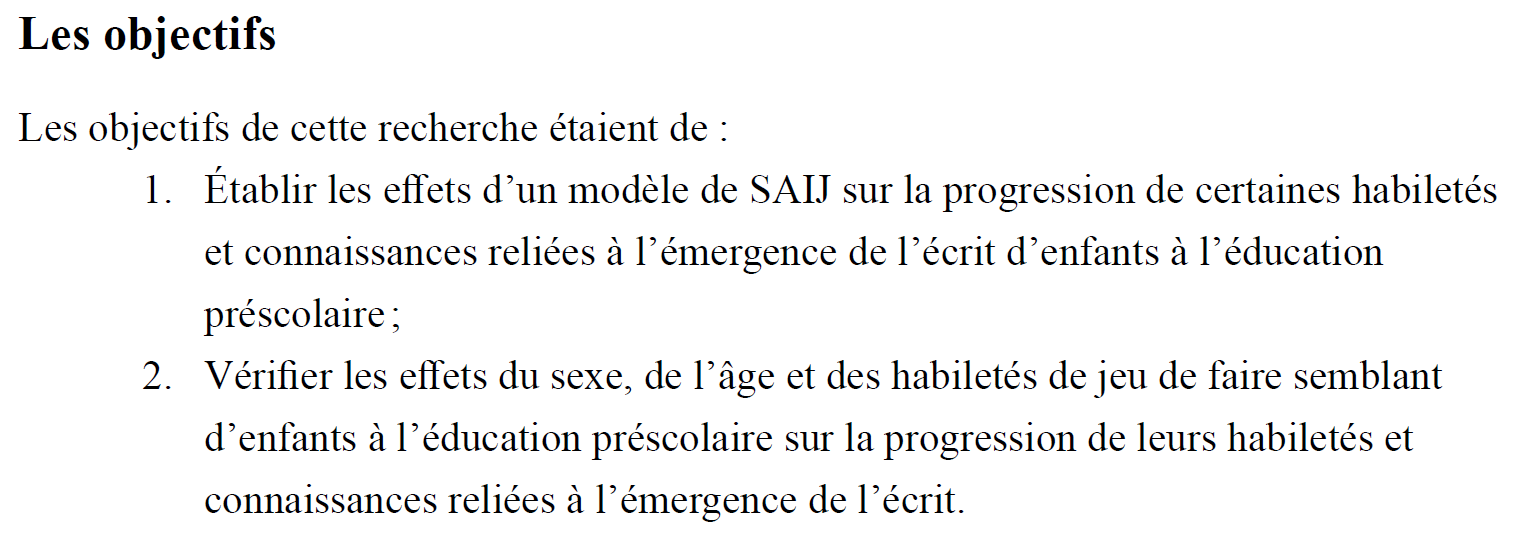
This study aimed to establish the effects of a model of learning situations drawn from play (LSDP) on the progression of certain skills and knowledge related to the emergence of writing in 5-year-old children enrolled in preschool education. Quasi-experimental research design adopting a pre-test-intervention-post-test design was conducted with 363 children divided into two groups. The teachers of the experimental group applied the LSDP model during the experimental phase, while the teachers of the control group opted for direct and school-type teaching of the prerequisites of reading and writing. This study has shown that an LSDP model produces better results regarding the development of knowledge and skills related to the emergence of writing than school-based teaching. The results indicate that this model is particularly efficient for the development of the functional aspect of written language and that it is at least as efficient for conventional and sound aspects as direct teaching. Further, age and play skills are positively associated with the progression of the emergence of writing, while participants’ sex is not, regardless of the pedagogical model.
Metrics
References
Aaron, P. G., Joshi, R. M., Palmer, H., Smith, N. et Kirby, E. (2002). Separating genuine cases of reading disability from reading deficits caused by predominantly inattentive ADHD behavior. Journal of Learning Disabilities, 35(5), 425–436. https://doi.org/10.1177/00222194020350050301
Allington, R. L. (2011). What at-risk readers need. Educational Leadership, 68(6), 40–45. https://ir.vnulib.edu.vn/bitstream/123456789/4056/1/6.WHAT%20AT-RISK%20READERS%20NEED.pdf
Bara, F., Gentaz, É. et Colé, P. (2008). Littératie précoce et apprentissage de la lecture : comparaison entre des enfants à risque, scolarisés en France dans des réseaux d’éducation prioritaire, et des enfants de classes régulières. Revue des sciences de l’éducation, 34(1), 27–45. https://doi.org/10.7202/018988ar
Beaupré, J. (2002). Effet de l’âge relatif sur l’ajustement social et scolaire d’enfants du primaire [Mémoire de maitrise, Université Laval]. Bibliothèque et Archives Canada. https://dam-oclc.bac-lac.gc.ca/fra/afdddf77-33f9-4764-b9bd-26edf8440397
Bell, J. F. et Daniels, S. (1990). Are summer-born children disadvantaged? The birthdate effect in education. Oxford Review of Education, 16(1), 67–80. https://doi.org/10.1080/0305498900160106
Bernier, J., Boudreau, M. et Mélançon, J. (2017). Regards sur la pédagogie du jeu au préscolaire. Revue canadienne des jeunes chercheures et chercheurs en éducation, 8(2), 70–78. https://journalhosting.ucalgary.ca/index.php/cjnse/article/view/42928
Bondioli, A. et Savio, D. (2009). Symbolic play abilities rating scale. Edizioni junior.
Brodeur, M., Gosselin, C., Mercier, J., Legault, F. et Vanier, N. (2006). Prévention des difficultés d’apprentissage en lecture : l’effet différencié d’un programme implanté par des enseignantes de maternelle chez leurs élèves. Éducation et francophonie, 34(2), 56–84. https://doi.org/10.7202/1079022ar
Brosseau-Lapré, F. et Rvachew, S. (2008). Test de connaissances phonologique préscolaire. https://www.mcgill.ca/child-phonology/files/child-phonology/tcpp.pdf
Brougère, G. (2005). Jouer/apprendre. Economica.
Camilli, G., Vargas, S., Ryan, S. et Barnett, W. S. (2010). Meta-analysis of the effects of early education interventions on cognitive and social development. Teachers College Record, 112(3), 579–620. https://doi.org/10.1177/016146811011200303
Carlsson-Paige, N., McLaughlin, G. B. et Almon, J. W. (2015). Reading instruction in kindergarten: Little to gain and much to lose. Defending the Early Years; Alliance for Childhood. https://files.eric.ed.gov/fulltext/ED609172.pdf
Chauveau, G. (2003). Comment l'enfant devient lecteur : pour une psychologie cognitive et culturelle de la lecture. Retz.
Clay, M. M. (1991). Becoming literate: The construction of inner control. Heinemann.
Creswell, J. W. (2014). A concise introduction to mixed methods research. Sage.
Delalande, J. (2003). Culture enfantine et règles de vie. Jeux et enjeux de la cour de récréation. Terrain, anthropologie et sciences humaines, 40, 99–114. https://doi.org/10.4000/terrain.1555
Desrosiers, H. et Tétreault, K. (2012, décembre). Les facteurs liés à la réussite aux épreuves obligatoires de français en sixième année du primaire : un tour d’horizon (Vol. 7, Fascicule 1). Institut de la statistique Québec. https://numerique.banq.qc.ca/patrimoine/details/52327/2243011
Deviterne, D., Tazouti, Y., Carol, R., Geiger-Jaillet, A., Matter, C. et Viriot-Goeldel, C. (2006). Étude comparative des effets de contextes de préscolarisation français et allemand sur les apprentissages fondamentaux des deux premières années de scolarisation [Rapport de recherche]. IUFM de Lorraine ; IUFM d’Alsace. https://shs.hal.science/halshs-00380255
Diamond, A. (2009). Apprendre à apprendre. The Research File, 2009(34), 88–92. https://www.ncbi.nlm.nih.gov/pmc/articles/PMC2950655/
Diamond, A., Barnett, W. S., Thomas, J. et Munro, S. (2007). Preschool program improves cognitive control. Science, 318(5855), 1387–1388. https://doi.org/10.1126/science.1151148
Duncan, G. J., Dowsett, C. J., Claessens, A., Magnuson, K., Huston, A. C., Klebanov, P., Pagani, L. S., Feinstein, L., Engel, M., Brooks-Gunn, J., Sexton, H., Duckworth, K. et Japel, C. (2007). School readiness and later achievement. Developmental Psychology, 43(6), 1428–1446. https://doi.org/10.1037/0012-1649.43.6.1428
Elkonin, D. B. (2005). The subject of our research: The developed form of play. Journal of Russian & East European Psychology, 43(1), 22–48. https://doi.org/10.1080/10610405.2005.11059242
Florin, A. (2016). Le développement du langage (2e éd.). Dunod.
Foulin, J.-N. et Pacton, S. (2006). La connaissance du nom des lettres : précurseur de l’apprentissage du son des lettres. Éducation et francophonie, 34(2), 28–56. https://doi.org/10.7202/1079021ar
Giasson, J. (2003). La lecture : de la théorie à la pratique. Gaëtan Morin.
Giasson, J. (2011). La lecture : apprentissage et difficultés. Gaëtan Morin.
Gillain-Mauffette, A. (2015). L’enseignement précoce et systématique de la lecture/écriture peut nuire aux jeunes enfants en particulier ceux issus de milieux défavorisés, alors pourquoi l’adopter en maternelle 4 et 5 ans ? Revue Préscolaire, 53(3), 13–15. https://aepqkiosk.milibris.com/revue-prescolaire/revue-prescolaire/n533-2015
Grondin, S., Proulx, J. et Zhou, R.-M. (1993). Date de naissance et rendement scolaire. Apprentissage et socialisation, 16(1-2), 169–174.
Halliday, M. A. K. (1973). Explorations in the functions of language. Edward Arnold.
Hancock, F. (2008). Emerging literacy. Dans T. Linder (dir.), Transdisciplinary playbased assessment (2e éd., p. 401–433). Paul H. Brookes.
Hirsh-Pasek, K. et Golinkoff, R. M. (2011). The great balancing act: Optimizing core curricula through playful pedagogy. Dans E. Zigler, W. S. Gilliam et W. S. Barnett (dir.), The pre-K debates: Current controversies and issues (p. 110–116). Paul H. Brookes.
Institut de la Statistique du Québec. (2018). Enquête québécoise sur le développement des enfants à la maternelle 2017 : portrait statistique pour le Québec et ses régions administratives. https://statistique.quebec.ca/fr/fichier/enquete-quebecoise-sur-le-developpement-des-enfants-a-la-maternelle-2017-portrait-statistique-pour-le-quebec-et-ses-regions-administratives.pdf
Jakubowski, M. et Borgonovi, F. (2012). Quels enseignements peut-on tirer du PISA : l’exemple des écarts de performances entre les sexes. Recherches en éducation, (14). https://doi.org/10.4000/ree.5344
Leong, D. J. et Bodrova, E. (2012). Assessing and scaffolding make-believe play. Young children, 67(1), 28–34. https://www.jstor.org/stable/42731123
Leslie, A. M. et Chen, M. L. (2007). Individuation of pairs of objects in infancy. Developmental Science, 10(4), 423–430. https://doi.org/10.1111/j.1467-7687.2007.00596.x
Levin, D. E. (2013). Beyond remote-controlled childhood: Teaching young children in the media age. National Association for the Education of Young Children. https://archive.org/details/beyondremotecont0000levi
Limbrick, L. M. (2022). Gender and reading: Are there really more boys than girls who struggle with reading? [Thèse de Doctorat, Macquarie University]. Figshare. https://figshare.mq.edu.au/articles/thesis/Gender_and_reading_are_there_really_more_boys_than_girls_who_struggle_with_reading_/19434242
Little, M. H. et Cohen-Vogel, L. (2016). Too much too soon? An analysis of the discourses used by policy advocates in the debate over kindergarten. Education Policy Analysis Archives, 24(106), 31–35. https://doi.org/10.14507/epaa.24.2293
Lonigan, C. J., Wagner, R. K., Torgesen, J. K. et Rashotte, C. A. (2007). TOPEL: Test of preschool early literacy. Super Duper Publications.
Marcon, R. A. (2002). Moving up the grades: Relationship between preschool model and later school success. Early Childhood Research & Practice, 4(1), 1–24. https://files.eric.ed.gov/fulltext/ED464762.pdf
Marinova, K. (2014). L’intervention éducative au préscolaire : un modèle de pédagogie du jeu. Presses de l’Université du Québec.
Marinova, K. (2015). Les situations d’apprentissage issues du jeu : forme ludique ou/et forme scolaire ? Dans C. Bouchard, A. Charron et N. Bigras (dir.), Actes du colloque 514. Le jeu en contextes éducatifs pendant la petite enfance, 7 et 8 mai 2013 (p. 93–106). Équipe de recherche FRQ-SC Qualité éducative des services de garde et petite enfance ; Crires. https://lel.crires.ulaval.ca/works/bouchard_charron_bigras_2015.pdf
Marinova, K., Dumais, C., Moldoveanu, M., Dubé, F. et Drainville, R. (2020). Les pratiques enseignantes pour soutenir les premiers apprentissages de la langue écrite à l’éducation préscolaire : entre l’approche développementale et l’approche scolarisante. Revue des sciences de l’éducation de McGill, 55(2), 352–375. https://doi.org/10.7202/1077972ar
Marinova, K., Dumais, C., Niyubahwe, A. et Nolin, R. (2023, 3–5 juillet). The effect of sex on emergence of written language in preschool children exposed to two learning models [Communication orale]. 15th International Conference on Education and New Learning Technologies, Palma, Espagne. https://doi.org/10.21125/edulearn.2023.0156
Marinova, K., Dumais, C., Campbell, B. et Baril. M.-P. (2024). Adapter et mettre en oeuvre un modèle de situations d'apprentissage issues du jeu symbolique pour soutenir l'émergence de l'écrit chez les enfants de l'éducation préscolaire [Rapport de recherche]. Fonds de recherche Société et culture du Québec. https://frq.gouv.qc.ca/app/uploads/2024/05/rapport-krasimira-marinova-2020-0lita-278684.pdf
Ministère de l’Éducation du Québec (MEQ). (2001). Programme de l’éducation préscolaire. Gouvernement du Québec.
Ministère de l’Éducation du Loisir et du Sport (MELS). (2009). La lecture et l’écriture chez les garçons… de A à Z. Comment aider les garçons en lecture et en écriture ? Compte-rendu d’une recherche-action collaborative effectuée sur une période de cinq ans auprès de garçons de milieux défavorisés. Gouvernement du Québec. https://numerique.banq.qc.ca/patrimoine/details/52327/1944917
National Early Literacy Panel (NELP). (2008). Developing early literacy: Report of the National Early Literacy Panel. A scientific synthesis of early literacy development and implications for intervention. National Institute for Literacy; National Center for Family Literacy. https://lincs.ed.gov/publications/pdf/NELPReport09.pdf
Onatsu-Arvilommi, T. et Nurmi, J.-E. (2000). The role of task-avoidant and task-focused behaviors in the development of reading and mathematical skills during the first school year: A cross-lagged longitudinal study. Journal of Educational Psychology, 92(3), 478–491. https://doi.org/10.1037/0022-0663.92.3.478
Pagani, L. S., Fitzpatrick, C., Belleau, L. et Janosz, M. (2011, octobre). Prédire la réussite scolaire des enfants en quatrième année à partir de leurs habiletés cognitives, comportementales et motrices à la maternelle (vol. 6, fascicule 1). Institut de la statistique Québec. https://numerique.banq.qc.ca/patrimoine/details/52327/2076717
Parker, A. et Neuharth-Pritchett, S. (2006). Developmentally appropriate practice in kindergarten: Factors shaping teacher beliefs and practice. Journal of Research in Childhood Education, 21(1), 65–78. https://doi.org/10.1080/02568540609594579
Pellegrini, A. D. et Galda, L. (1990). Children's play, language, and early literacy. Topics in Language Disorders, 10(3), 76–88. https://doi.org/10.1097/00011363-199006000-00008
Prochnow, J. E., Tunmer, W. E., Chapman, J. W. et Greaney, K. T. (2001). A longitudinal study of early literacy achievement and gender. New Zealand Journal of Educational Studies, 36(2), 221–236.
Puranik, C. S. et Lonigan, C. J. (2011). From scribbles to scrabble: Preschool children's developing knowledge of written language. Reading and Writing, 24(5), 567–589. https://doi.org/10.1007/s11145-009-9220-8
Rohde, L. (2015). The comprehensive emergent literacy model: Early literacy in context. Sage Open, 5(1), 1–11. https://doi.org/10.1177/2158244015577664
Roskos, K. A. et Christie, J. F. (2000). Play and literacy in early childhood: Research from multiple perspectives. Lawrence Erlbaum.
Roskos, K. A. et Christie, J. F. (2011). The play-literacy nexus and the importance of evidence-based techniques in the classroom. American Journal of Play, 4(2), 204–224. https://files.eric.ed.gov/fulltext/EJ985588.pdf
Sawyer, R. K. (2001). Play as improvisational rehearsal: Multiple levels of analysis in children’s play. Dans A. Goncü et E. Klein (dir.), Children in play, story, and school (p. 19–38). Guilford.
Shanahan, T. et Lonigan, C. J. (2013). Early childhood literacy : The National Early Literacy Panel and beyond. Paul H. Brookes.
Stipek, D. (2006). No child left behind comes to preschool. The Elementary School Journal, 106(5), 455–466. https://doi.org/10.1086/505440
Strickland, D. et Morrow, L. (2000). Beginning reading and writing. Teachers College Press.
Suggate, S. P., Schaughency, E. A. et Reese, E. (2013). Children learning to read later catch up to children reading earlier. Early Childhood Research Quarterly, 28(1), 33–48. https://doi.org/10.1016/j.ecresq.2012.04.004
Thériault, J. et Lavoie, N. (2004). L’éveil à la lecture et à l’écriture : une responsabilité familiale et communautaire. Logiques.
Thériault, P. (2008). Savoirs et interventions éducatives d’enseignantes de la maternelle quatre ans en milieux défavorisés concernant le développement de la conscience de l’écrit [Thèse de Doctorat, Université du Québec à Montréal]. Archipel. https://archipel.uqam.ca/2000/
Toub, T. S., Rajan, V., Golinkoff, R. M. et Hirsh-Pasek, K. (2016). Guided play: A solution to the play versus learning dichotomy. Dans D. C. Geary et D. B. Berch (dir.), Evolutionary perspectives on child development and education (p. 117–141). Springer International. https://doi.org/10.1007/978-3-319-29986-0_5
Treiman, R., Kessler, B. et Pollo, T. C. (2006). Learning about the letter name subset of the vocabulary: Evidence from US and Brazilian preschoolers. Applied Psycholinguistics, 27(2), 211–227. https://doi.org/10.1017/S0142716406060255
Veneziano, E. (2002). Relations entre jeu de fiction et langage avant trois ans : de l’émergence de la fonction sémiotique à celle de la “théorie de l’esprit” en action. Enfance, 54(3), 241–257. https://shs.cairn.info/revue-enfance1-2002-3-page-241?lang=fr
Veneziano, E. (2005). Langage dans le jeu de faire semblant : une manière d’évaluer la théorie implicite de l’esprit chez l’enfant ? Langage et Pratiques, 35, 5–15. https://www.fse.ulaval.ca/fichiers/site_www/documents/A_l_agenda/Edy_Veneziano/3-Langage_dans_le_jeu_de_faire_semblant.pdf
Viriot-Goeldel, C., Tazouti, Y., Geiger-Jaillet, A., Matter, C., Carol, R. et Deviterne, D. (2009). Comparaison des effets des variables individuelles et contextuelles sur les performances scolaires des élèves en France et en Allemagne à la fin des deux premières années de scolarisation. Recherches et Éducations, (2), 233–253. https://doi.org/10.4000/rechercheseducations.528
Vygotskij, L. S. (2022). Le jeu et son rôle dans le développement psychologique de l’enfant. Dans B. Schneuwly, I. Leopoldoff Martin et D. N. Henrique Silva (dir.), L.S. Vygotskij : Imagination (textes choisis) (I. Leopoldoff Martin, trad., p. 41–55). Peter Lang. (Texte original publié en 1933)
Vygotsky, L. S. (2011b). Le problème de l’apprentissage et de développement naturel à l’âge scolaire. Dans F. Yvon et Y. Zinchenko (dir.), Vygotsky, une théorie du développement et de l’éducation (L. Chaiguerova, trad., p. 221–247). Université d’État de Moscou. (Texte original publié en 1934)
Vygotsky, L. S. (2011a). La périodisation du développement de l’enfant. Dans F. Yvon et Y. Zinchenko (dir.), Vygotsky, une théorie du développement et de l’éducation (L. Chaiguerova, trad., p. 111–134). Faculté de psychologie de l’Université d’État de Moscou. (Ouvrage original publié en 1934)
Weininger, O. et Fitzgerald, D. (1988). Symbolic play and interhemispheric integration: Some thoughts on a neuropsychological model of play. Journal of Research & Development in Education, 21(4), 23–40.
Weisberg, D. S., Zosh, J. M., Hirsh-Pasek, K. et Golinkoff, R. M. (2013). Talking it up: Play, language, and the role of adult support. American Journal of Play, 6(1), 39–54. https://files.eric.ed.gov/fulltext/EJ1016058.pdf
Whitebread, D., Basilio, M., Kuvalja, M. et Verma, M. (2012, avril). The importance of play. Toy Industries of Europe. https://www.waldorf-resources.org/fileadmin/files/pictures/Early_Childhood/dr_david_whitebread_-_the_importance_of_play.pdf
Whitehurst, G. J. et Lonigan, C. J. (1998). Child development and emergent literacy. Child Development, 69(3), 848–872. https://doi.org/10.1111/j.1467-8624.1998.tb06247.x
Downloads
Published
How to Cite
Issue
Section
License
Copyright (c) 2025 Canadian Society for the Study of Education

This work is licensed under a Creative Commons Attribution-NonCommercial-NoDerivatives 4.0 International License.
The Canadian Journal of Education follows Creative Commons Licencing CC BY-NC-ND.